

The demand for women’s ethnic wear continues to remain strong across India. From everyday suits and comfortable palazzo sets to shararas, gowns and lehengas for special occasions, ethnic fashion has become an important part of the Indian fashion market.
For retailers and resellers, this creates a strong opportunity to build a profitable ethnic wear business. However, buying wholesale women’s ethnic wear is not simply about finding attractive designs at a low price.
The products you choose can directly affect your customer satisfaction, sales, profit margins and repeat business.
A collection may look impressive in photographs, but retailers need to consider several other factors before placing a wholesale order. Fabric quality, finishing, customer preferences, sizing, stock availability and supplier reliability can all influence whether a product performs well in the market.
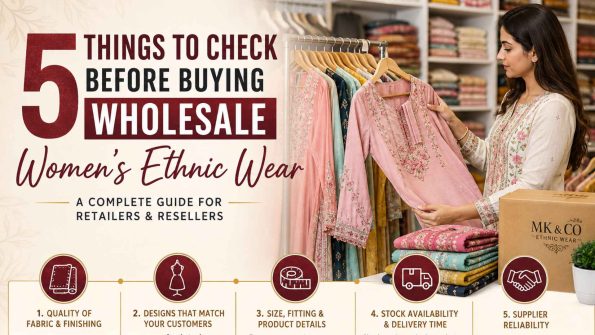
So, what should you check before buying wholesale women’s ethnic wear?
Here are five important factors every retailer and reseller should consider.
1. Check the Quality of Fabric and Overall Finishing
Quality should always be one of the first things you evaluate before buying ethnic wear in bulk.
Customers may initially notice a design, colour or pattern, but the quality of the garment is what determines their overall experience. If the fabric feels uncomfortable, the stitching is poor or the finishing is inconsistent, customers may hesitate to purchase again.
When evaluating a wholesale ethnic wear collection, pay attention to the material and construction of each product.
Things to check include:
- Fabric quality and feel
- Stitching and seams
- Embroidery quality
- Print clarity
- Colour consistency
- Dupatta finishing
- Lining and inner construction
- Buttons, zippers and other accessories
- Overall garment finishing
It is also useful to understand whether the fabric is appropriate for the intended use of the outfit.
For example, customers shopping for everyday ethnic wear may prefer lightweight and comfortable fabrics, while customers purchasing wedding or festive outfits may be more interested in detailed embroidery, embellishments and richer designs.
Why does quality matter for retailers?
Poor-quality products can result in complaints, exchanges and negative customer experiences.
On the other hand, consistent quality can help retailers build trust with their customers. When customers know that a store regularly offers well-finished products, they are more likely to return when they need another outfit.
This is particularly important for retailers who want to build a long-term fashion business rather than simply make one-time sales.
2. Choose Designs Based on Your Customers, Not Just Trends
One of the biggest mistakes retailers can make is buying products simply because they personally like the designs.
Fashion preferences can differ significantly between customer groups.
A collection that performs well in one market may not necessarily perform equally well in another. Customer age, location, spending capacity, lifestyle and the type of occasions they attend can all influence what they prefer to buy.
Before purchasing wholesale women’s ethnic wear, understand your target customer.
Ask yourself:
- Who are my main customers?
- What age group do they belong to?
- Are they looking for everyday or occasion wear?
- What price range do they usually prefer?
- Which colours and styles sell better in my area?
- Do they prefer traditional or contemporary designs?
- Are they buying for themselves or for gifting?
Once you understand your customers, you can create a more relevant product mix.
Build a balanced collection
Instead of stocking only one type of outfit, retailers can consider creating a collection across different categories.
For example:
Straight Suits:
Suitable for everyday wear, office occasions, casual gatherings and simple festive looks.
Sharara Suits:
A popular choice for festive celebrations, mehendi functions, family events and pre-wedding occasions.
Palazzo Suits:
A comfortable option that combines traditional styling with a modern silhouette.
Indo-Western Outfits:
Useful for customers who want ethnic elements with a more contemporary fashion look.
Gowns:
A strong option for parties, receptions, evening functions and special occasions.
Lehengas:
Suitable for weddings, engagements, festive celebrations and other important events.
The objective isn’t to stock everything available in the market. Instead, retailers should select categories that fit their customer base.
3. Check Size, Fitting and Product Information
A beautiful ethnic outfit can still become difficult to sell if the sizing information is unclear or inconsistent.
For retailers, proper sizing is especially important because customers want confidence that the outfit they purchase will fit comfortably.
Before placing a wholesale order, check whether the supplier provides proper measurements and clear product specifications.
Important details to check:
- Available sizes
- Bust measurements
- Waist measurements
- Hip measurements where applicable
- Kurta or top length
- Bottom length
- Dupatta size
- Fabric details
- Fit type
- Product components
If you sell through an online store, Instagram, WhatsApp or other digital channels, accurate product information becomes even more important.
Customers cannot physically try the product before purchasing online. Therefore, clear measurements and product descriptions can make their buying decision easier.
Consistent sizing helps retailers
Suppose a customer purchases two outfits from the same collection. If the sizing is significantly different between the two products, it can create confusion and dissatisfaction.
Consistent sizing and accurate product information make it easier for retailers to recommend products and manage customer expectations.
For online sellers, it can also help reduce unnecessary exchanges caused by incorrect size selection.
4. Check Stock Availability, Dispatch and Delivery
Another important factor that retailers often overlook is product availability.
Imagine a particular ethnic wear design starts selling quickly in your store. Customers begin asking for the same design in different colours or sizes, but your supplier has no stock available.
You may lose sales simply because you cannot replenish your inventory quickly.
That is why stock availability should be considered before choosing a wholesale supplier.
Before placing an order, ask about:
- Ready stock availability
- Minimum order quantity
- Dispatch time
- Shipping options
- Restocking process
- Availability of popular designs
- Size availability
- Colour availability
- Order processing time
Ready stock can be particularly useful
For retailers, ready-to-ship products can make inventory management easier.
Instead of waiting for products to be manufactured after every order, retailers can replenish fast-moving products when stock becomes low.
This can be especially useful during high-demand periods such as:
- Wedding seasons
- Diwali
- Navratri
- Eid
- Raksha Bandhan
- Karwa Chauth
- Festive shopping periods
- Local celebrations
Demand can increase quickly during these periods, so having access to readily available products can help retailers respond faster.
Don’t only look at delivery speed
Fast delivery is useful, but reliability is even more important.
A supplier who consistently dispatches orders within the promised timeframe is generally more valuable than one who occasionally offers extremely fast delivery but frequently causes delays.
For a retailer, predictable stock movement makes planning much easier.
5. Check the Reliability of the Wholesale Supplier
The final and perhaps one of the most important things to evaluate is the supplier itself.
A wholesale supplier isn’t simply someone who provides products. Over time, they can become an important part of your business operation.
If your supplier provides consistent quality, communicates clearly and maintains stock availability, managing your retail business becomes easier.
However, unreliable suppliers can create problems with inventory, customer orders and cash flow.
Before working with a supplier, consider:
Experience:
How long have they been operating in the ethnic wear industry?
Product consistency:
Does the quality remain consistent from one order to another?
Communication:
Are they responsive when you have questions regarding products or orders?
Order processing:
Are orders processed accurately and efficiently?
Packaging:
Are products packed properly to reduce the chances of damage during transportation?
Dispatch:
Does the supplier ship orders within the promised timeframe?
Product availability:
Can they provide popular products when you need to replenish your inventory?
Start small before scaling
If you are working with a supplier for the first time, you don’t necessarily need to place a very large order immediately.
A smaller initial order can help you evaluate:
- Product quality
- Finishing
- Packaging
- Size consistency
- Delivery time
- Communication
- Customer response
Once you are satisfied with the overall experience, you can gradually increase your purchasing volume.
This approach can help retailers make better purchasing decisions and reduce unnecessary risk.
Wholesale Price Is Important, But It Shouldn’t Be the Only Factor
Price naturally matters when buying wholesale.
Retailers need to calculate their costs and ensure that products can be sold at a reasonable margin. However, choosing a supplier solely because they offer the lowest price can sometimes create problems later.
A lower purchase price does not always mean better value.
For example, if a cheaper product has inconsistent quality, poor finishing or low customer demand, the retailer may struggle to sell it.
A slightly higher-quality product may provide better value if customers are willing to pay for it and the product generates repeat purchases.
Think about total value
When comparing wholesale suppliers, consider:
Product quality + customer demand + supplier reliability + stock availability + purchase price
rather than simply comparing the wholesale price.
The objective should be to purchase products that offer a good balance between quality, demand and profitability.
Keep a Mix of Basic and Occasion Wear
Another useful strategy for retailers is to maintain a balanced collection.
Not every customer is shopping for a wedding or major celebration. Some customers want comfortable outfits for regular use, while others are looking for statement pieces for special occasions.
A collection can therefore include both everyday and occasion-focused products.
Everyday ethnic wear
Examples include:
- Simple straight suits
- Printed suits
- Comfortable palazzo sets
- Lightweight ethnic outfits
These can appeal to customers who want practical clothing for regular use.
Occasion wear
Examples include:
- Embroidered shararas
- Designer-inspired suits
- Ethnic gowns
- Lehengas
- Heavily detailed festive outfits
These products can appeal to customers shopping for weddings, festivals, parties and celebrations.
A combination of both categories can help retailers serve a wider range of customer needs.
Don’t Ignore Seasonal Demand
Ethnic wear demand can change throughout the year.
Retailers should pay attention to upcoming festivals, wedding seasons and local events when planning their inventory.
For example, demand for festive and wedding outfits may increase significantly before major celebration periods.
This means retailers should ideally plan inventory ahead of time rather than waiting until demand has already increased.
A simple planning approach
Before a major season:
- Review last year’s sales.
- Identify your fastest-selling categories.
- Check your current inventory.
- Identify products that need replenishment.
- Contact suppliers early.
- Plan your new collection.
- Keep some room for fast-moving products.
This can help retailers avoid both stock shortages and unnecessary overstocking.
Why the Right Wholesale Partner Can Make a Difference
Retailers need more than attractive products to grow an ethnic wear business.
They need a wholesale partner that understands the importance of:
- Consistent product quality
- Current fashion preferences
- Product variety
- Ready stock
- Timely dispatch
- Reliable communication
- Long-term business relationships
When these factors come together, retailers can focus more on selling and building their customer base instead of constantly dealing with supply-related issues.
MK & CO: Ethnic Wear for Retailers and Resellers
For retailers and resellers looking for a diverse range of women’s ethnic wear, MK & CO offers collections across multiple categories.
The range includes straight suits, sharara suits, palazzo suits, Indo-Western outfits, gowns, crop-top sets and straight lehengas, giving businesses the flexibility to build a collection according to their customer preferences.
With in-house manufacturing, live SKUs and ready-to-ship inventory, MK & CO focuses on making ethnic wear sourcing more convenient for retailers and resellers.
For a business purchasing wholesale ethnic wear, the goal should always be to find the right combination of product quality, attractive designs, stock availability and dependable service.
Whether you’re an established retailer expanding your collection or a reseller looking for new ethnic wear products, evaluating these factors before placing an order can help you make more informed purchasing decisions.
Final Checklist Before Buying Wholesale Women’s Ethnic Wear
Before placing your next wholesale order, take a moment to review this checklist:
✅ 1. Fabric & Quality
Is the fabric suitable for the product? Is the stitching and finishing consistent?
✅ 2. Customer Demand
Are the designs suitable for your target customers?
✅ 3. Size & Fitting
Are measurements and product details accurate and clearly available?
✅ 4. Stock & Delivery
Is the supplier able to provide ready stock and dispatch products reliably?
✅ 5. Supplier Reliability
Can you depend on the supplier for consistent quality, communication and service?
If the answer to all five is yes, you are in a much stronger position to make a confident wholesale purchase.
Conclusion
Buying wholesale women’s ethnic wear is an important decision for any retailer or reseller.
The right collection can help you attract customers, improve repeat sales and build a stronger fashion business. But achieving this requires looking beyond designs and prices.
Before buying, always evaluate quality, customer demand, sizing, stock availability and supplier reliability.
A thoughtful purchasing strategy can help retailers reduce unnecessary inventory problems while building a collection that customers actually want to buy.
In a competitive ethnic fashion market, the right products and the right wholesale partner can make a meaningful difference to long-term business growth.