

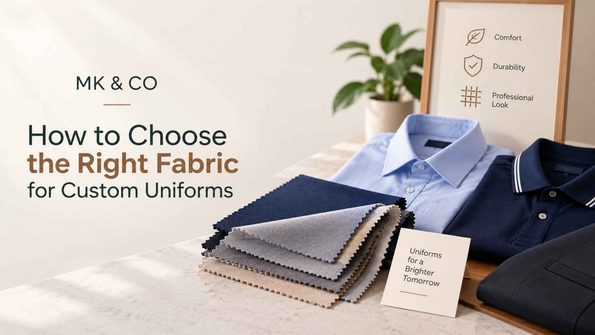
When businesses order custom uniforms, most people immediately focus on the logo, colour, design, and overall appearance. While these elements are important, there is another decision that can have an even bigger impact on the final result: choosing the right fabric.
The fabric used for a uniform affects how comfortable it feels, how long it lasts, how it looks after repeated washing, and how suitable it is for the employee’s working environment.
A uniform designed for an office may require very different fabric characteristics from one designed for a restaurant, warehouse, outdoor service business, or hospitality environment.
Choosing the right fabric therefore isn’t simply a matter of appearance. It is about finding the right balance between comfort, durability, functionality, appearance, and cost.
Why Fabric Choice Matters for Custom Uniforms
Employees may wear uniforms for several hours every day. If the fabric is uncomfortable, too heavy, difficult to maintain, or unsuitable for the working environment, it can affect the overall experience of wearing the uniform.
A good uniform fabric should ideally be:
- Comfortable for extended wear
- Suitable for the working environment
- Durable enough for regular use
- Easy to wash and maintain
- Appropriate for the company’s brand image
- Suitable for embroidery or printing
- Available in the required colours and styles
The right choice can make a uniform look better while also making it more practical for everyday use.
1. Consider the Working Environment
The first question to ask is where the uniform will be worn.
An employee working inside an air-conditioned office has very different clothing requirements from someone working outdoors during hot weather.
Office and Corporate Work
Corporate uniforms often prioritise a clean and professional appearance.
Shirts, polo shirts, jackets, and other structured garments can work well when made from fabrics that maintain their shape and appearance throughout the working day.
Restaurants and Hospitality
Restaurant and hospitality employees may need uniforms that are comfortable, easy to clean, and suitable for long shifts.
The fabric should be practical for frequent washing while maintaining a professional appearance.
Outdoor Work
Employees working outdoors may need lightweight and breathable materials that allow comfortable movement.
Weather conditions should also be considered when selecting workwear.
Industrial and Heavy-Duty Work
For physically demanding jobs, durability becomes particularly important.
Uniforms should be selected based on the level of movement, friction, exposure, and daily wear involved in the job.
2. Comfort Should Be a Priority
A uniform may look excellent, but if employees don’t feel comfortable wearing it, it isn’t a successful uniform.
Comfort becomes especially important when employees wear the same clothing for long working hours.
When evaluating a fabric, consider:
- Breathability
- Weight
- Softness
- Flexibility
- Moisture management
- Temperature
- Overall feel against the skin
A lightweight fabric may be more suitable for warm environments, while a heavier fabric can be useful when additional structure or warmth is required.
3. Think About Durability
Businesses often purchase uniforms for multiple employees, so durability can have a significant impact on long-term value.
A uniform used every day may experience frequent washing, repeated movement, friction, stretching, exposure to dirt, ironing, and general workplace wear.
Choosing a fabric designed for the intended level of use can help uniforms maintain their appearance for longer.
This is particularly important for businesses where employees wear uniforms every working day.
4. Consider How Often the Uniform Will Be Washed
Different businesses have different washing requirements.
Hospitality, food service, healthcare, cleaning, and other industries may require uniforms to be washed frequently.
In such cases, fabric selection should take repeated washing into consideration.
A suitable uniform fabric should maintain its shape, colour, and overall appearance with proper care.
Before placing a large order, businesses should understand the recommended washing and maintenance requirements for the chosen garment.
5. Cotton for Comfortable Everyday Uniforms
Cotton is a popular choice for many types of clothing because of its comfortable and natural feel.
Cotton garments can be suitable for businesses that prioritise comfort and a casual or smart-casual appearance.
They can work particularly well for:
- Polo shirts
- T-shirts
- Casual uniforms
- Promotional apparel
- Everyday branded clothing
However, the specific cotton construction and garment quality matter, so businesses should evaluate the complete garment rather than choosing fabric based on fibre type alone.
6. Polyester for Durable Workwear
Polyester is widely used in workwear and uniforms because it can offer durability and practical performance.
It is often chosen for garments that need to handle regular use and repeated washing.
Polyester-based fabrics can be suitable for:
- Work uniforms
- Sportswear
- Staff uniforms
- Outdoor apparel
- Performance-oriented clothing
The right polyester fabric can provide a practical combination of durability and easy maintenance.
7. Cotton-Polyester Blends
For many businesses, a blend can offer a useful middle ground.
Cotton-polyester fabrics combine characteristics of both materials and are commonly used for uniforms and everyday workwear.
Depending on the blend and construction, businesses may benefit from a combination of:
- Comfort
- Durability
- Shape retention
- Easier maintenance
- Professional appearance
This makes blended fabrics a popular option for businesses looking for versatile uniforms.
8. Choose Fabric According to the Season
Climate should also influence your uniform decision.
For warmer environments, lightweight and breathable fabrics can help improve comfort.
For cooler environments, businesses may consider heavier shirts, sweatshirts, jackets, or layered workwear.
A business operating throughout the year may even need different uniform options for different seasons.
For example:
Summer: Lightweight shirts, polo shirts, and breathable fabrics.
Winter: Sweatshirts, jackets, heavier shirts, and layered uniforms.
This approach can help employees remain comfortable while maintaining consistent branding throughout the year.
9. Think About Embroidery and Printing
If your business plans to add a logo, fabric selection becomes even more important.
Not every garment behaves the same way when embroidered or printed.
For embroidered branding, the garment should be able to support the stitching without creating an undesirable appearance.
For printed designs, the fabric surface and construction can influence how the final graphic looks.
The size and complexity of your logo should also be considered before selecting the garment.
A professional custom apparel provider can help determine which combination of garment and branding method is most suitable.
10. Don’t Forget the Fit
Fabric is only one part of a successful uniform.
The fit of the garment also affects how professional and comfortable it looks.
Depending on the business, you may need:
- Regular fit
- Slim fit
- Relaxed fit
- Unisex styles
- Men’s and women’s sizing
- Different size ranges
Employees should be able to move comfortably while still presenting a consistent professional appearance.
A uniform that looks good in a product catalogue may not necessarily work well for employees performing physically demanding tasks.
11. Match the Fabric to Your Brand Image
Your uniform should represent your business.
A premium corporate company may want structured garments that communicate sophistication.
A casual café may prefer comfortable polo shirts or T-shirts.
A construction or maintenance company may prioritise durability and practical workwear.
A luxury hotel may require a more refined and formal appearance.
The fabric, garment style, colours, logo placement, and finishing should all work together to create a consistent brand identity.
12. Consider Employee Feedback
Employees are the people who will actually wear the uniforms, so their feedback can be valuable.
Before placing a large order, consider providing samples and asking employees about:
- Comfort
- Fit
- Fabric feel
- Weight
- Breathability
- Ease of movement
- Overall appearance
This can help identify potential problems before the business commits to a large uniform order.
A uniform should work for the people wearing it, not just look good in a product photograph.
13. Don’t Choose Based Only on Price
Cost is naturally an important consideration when ordering uniforms, especially for larger teams.
However, choosing the cheapest option isn’t always the most cost-effective decision.
A lower-cost garment may require replacement sooner if it isn’t suitable for regular use.
Instead of looking only at the initial price, consider the overall value.
Ask yourself:
How often will the uniform be worn?
How frequently will it be washed?
How long should it last?
What level of comfort is required?
Does it represent the brand appropriately?
The answers can help determine which fabric and garment provide the best long-term value.
Custom Uniforms for Different Businesses
Different industries have different uniform requirements.
Corporate Offices
Focus on professional appearance, comfort, fit, and easy maintenance.
Restaurants
Prioritise comfort, durability, easy cleaning, and suitability for long shifts.
Hotels
Focus on presentation, comfort, brand consistency, and a polished appearance.
Retail Stores
Choose garments that allow employees to remain comfortable while presenting a consistent brand identity.
Schools
Durability, comfort, easy maintenance, and consistent school branding can all be important.
Service Businesses
Workwear should allow movement while providing a professional appearance when employees interact with customers.
Events and Promotions
Comfort and strong brand visibility are often priorities because staff may spend long hours interacting with visitors.
How MK & CO Can Help
Choosing the right custom uniform involves more than selecting a shirt and adding a logo.
The garment, fabric, fit, colour, branding method, and intended use all need to work together.
MK & CO provides customised apparel and branded clothing solutions for businesses looking to create a consistent and professional appearance.
Whether you need corporate uniforms, embroidered workwear, branded polo shirts, custom apparel, or uniforms for your team, explore MK & CO for your custom clothing requirements.
Final Thoughts
Choosing the right fabric is one of the most important decisions when creating custom uniforms.
The best fabric depends on several factors, including the working environment, climate, comfort requirements, durability, washing frequency, garment style, and branding method.
Instead of choosing a uniform based purely on appearance or price, businesses should think about how the garment will actually be used every day.
When the right fabric is combined with the right fit, professional branding, and consistent design, a uniform can become a valuable part of your company’s identity.
A well-designed uniform doesn’t just make employees look organised. It helps create a consistent and recognisable image every time your team interacts with customers.
For custom uniforms and branded apparel, visit MK & CO.