

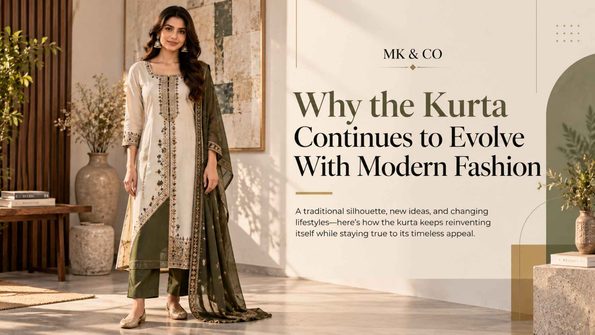
The kurta has been a part of Indian fashion for generations. It has remained familiar, comfortable, and deeply connected to traditional dressing, yet its appearance has never stayed exactly the same.
Over time, changing lifestyles, fashion preferences, fabrics, colours, silhouettes, and styling choices have given the kurta a fresh identity.
Today, the kurta can be traditional, contemporary, minimal, festive, relaxed, or even distinctly modern—while still retaining the essence that makes it recognisably Indian.
So, what allows such a traditional garment to keep evolving?
1. A Traditional Silhouette With Endless Possibilities
One of the biggest reasons behind the kurta’s continued popularity is its adaptable silhouette.
The basic idea remains simple, but designers can change the length, fit, neckline, sleeves, side slits, hemline, and overall structure to create completely different looks.
A straight-fit kurta can feel clean and contemporary, while a flowing Anarkali-inspired silhouette can create a more traditional appearance.
Relaxed fits can make the outfit suitable for everyday wear, while structured cuts can give it a more polished and sophisticated feel.
The foundation remains familiar, but the possibilities are almost endless.
2. Changing Lifestyles Are Influencing Design
Modern lifestyles have changed the way women choose their clothes.
Today, an outfit often needs to work around busy schedules, long days, social occasions, and different environments.
This has encouraged the development of kurtas that are easier to wear, move in, style, and repeat.
Lightweight fabrics, comfortable fits, practical lengths, and wearable designs have become increasingly important.
The modern kurta is therefore not simply designed to look beautiful. It is also designed to fit naturally into everyday life.
3. The Rise of Contemporary Necklines
The neckline is one of the easiest ways to give a traditional kurta a modern personality.
Classic round necks continue to remain popular, but contemporary designs can include V-necks, square necklines, keyhole details, collars, boat necks, and other variations.
Even a small change in the neckline can make the same basic silhouette feel completely different.
Designers can also use embroidery, piping, buttons, or contrasting fabrics around the neckline to create a stronger visual focus.
4. Sleeves Are Becoming More Experimental
Sleeves have also become an important part of modern kurta design.
Traditional straight sleeves can be replaced or enhanced with flared sleeves, three-quarter sleeves, cuffed designs, statement sleeves, or subtle embroidered details.
These changes allow designers to introduce contemporary fashion elements without losing the ethnic identity of the garment.
A simple kurta with an interesting sleeve design can feel completely new while remaining easy to recognise and wear.
5. Colours Keep Changing With Fashion
The kurta has also evolved through colour.
Traditional shades such as red, yellow, green, blue, and maroon continue to have a strong presence, especially in festive and occasionwear.
At the same time, modern ethnic collections increasingly explore pastels, earthy tones, muted neutrals, dusty shades, and contemporary colour combinations.
Soft pinks, sage greens, powder blues, ivory, beige, and muted lavender can give the kurta a lighter and more modern personality.
Colour allows the same traditional silhouette to connect with changing fashion preferences.
6. Prints Have Given the Kurta a Fresh Identity
Prints have always played an important role in Indian clothing, but modern fashion has expanded the way they are used.
Floral prints, geometric patterns, abstract motifs, traditional-inspired designs, and contemporary patterns can all be incorporated into kurta collections.
A printed kurta can feel relaxed and everyday-friendly, while a more detailed print can create a stronger fashion statement.
Prints also make it easier to experiment with colour without changing the basic silhouette.
7. Embroidery Is Becoming More Thoughtful
Modern kurta design is not necessarily about adding more embroidery.
Instead, the placement of embroidery has become increasingly important.
A detailed neckline, embroidered sleeve, delicate border, small motif, or beautifully finished hemline can add character without making the outfit feel heavy.
This approach allows traditional craftsmanship to work alongside modern minimalism.
The result is an outfit that feels detailed but still easy to wear.
8. The Kurta Is No Longer Limited to One Styling Formula
Another reason the kurta continues to evolve is its ability to work with different styling combinations.
A single kurta can be paired with straight pants, palazzos, shararas, skirts, trousers, or even denim depending on the desired look.
The addition of a dupatta, statement jewellery, belt, footwear, or handbag can further change its personality.
This flexibility makes the kurta one of the most adaptable pieces in an ethnic wardrobe.
9. The Dupatta Is Evolving Alongside It
The modern kurta is often styled differently depending on the occasion.
A lightweight printed dupatta can create a relaxed daytime look, while an embroidered or embellished dupatta can make the same kurta more suitable for celebrations.
Even the way the dupatta is draped can change the appearance of the entire outfit.
This creates more possibilities without requiring a completely different garment.
10. Comfort and Fashion Are Coming Together
For many modern consumers, comfort is no longer something separate from style.
People want clothing that looks polished while allowing them to move comfortably throughout the day.
This has influenced the development of relaxed silhouettes, breathable fabrics, practical designs, and lighter embellishment.
The modern kurta succeeds because it can provide this balance.
It can look traditional without feeling outdated, and fashionable without becoming difficult to wear.
11. From Everyday Wear to Occasionwear
The versatility of the kurta has also allowed it to move across different occasions.
A simple cotton or printed kurta can work for everyday activities.
A lightly embroidered set can be suitable for office gatherings, lunches, or family occasions.
A richly detailed kurta paired with an embellished dupatta and statement accessories can become an elegant festive look.
This range makes the kurta useful across different parts of a modern wardrobe.
12. Personal Style Is Changing the Way Kurtas Are Worn
Modern fashion is increasingly about individual expression.
Some women prefer minimal designs and neutral colours, while others enjoy bold prints, bright colours, and statement embroidery.
The kurta allows both approaches.
Its adaptable nature means it can be styled according to personal preference rather than following one fixed definition of ethnic fashion.
This ability to reflect different personalities is one of the reasons it continues to remain relevant.
13. Tradition Still Remains at the Core
Despite all these changes, the kurta has not lost its traditional identity.
Its appeal still comes from its connection to Indian clothing, craftsmanship, colours, textiles, and cultural aesthetics.
Modern design simply gives these familiar elements a new context.
A contemporary neckline does not make the garment less Indian. A modern silhouette does not remove its traditional character.
Instead, these changes help the kurta remain relevant to new generations.
What the Evolution of the Kurta Means for Ethnic Fashion
The journey of the kurta shows that traditional fashion does not have to remain unchanged to preserve its identity.
The most successful ethnic designs are often those that respect their roots while responding to the way people live today.
For retailers and resellers, this evolution also creates opportunities to offer collections that appeal to different customer preferences—from everyday minimal styles to festive statement pieces.
A modern ethnic collection can therefore include familiar silhouettes while experimenting with new colours, fabrics, details, and styling possibilities.
The Kurta Will Keep Evolving
Fashion continues to change, and the kurta will continue to change with it.
Future designs may explore new fabrics, silhouettes, colour palettes, details, and ways of styling, but the fundamental appeal of the garment is likely to remain the same.
It is comfortable, adaptable, recognisably Indian, and easy to make personal.
At MK & CO, we bring together the richness of Indian ethnicwear with contemporary design sensibilities, creating collections that reflect changing fashion preferences while staying connected to traditional craftsmanship.
🌐 Explore MK & CO: https://mkandco.co/
Final Thoughts
The kurta has survived changing trends because it was never limited to one particular style.
Its strength lies in its ability to adapt.
It can change with fashion without losing what makes it timeless—and that is exactly why the kurta continues to have a place in modern Indian wardrobes.
Really enjoyed this detailed explanation of how the kurta continues to evolve while preserving its traditional identity. The discussion on modern silhouettes, colours, comfort, and styling possibilities was especially insightful.